
FS Weekly - #008
Which First? | Beam Me Down | Titan


MAKING SPACE MAKE SENSE
Tech | Policy | Biz | Science | Rockets
Issue 008
Welcome to this week’s news of the next frontier. 🚀
On deck:
Which First?
Look Ma! No Flames!
Beam Me Down
High Ground
Titan
It’s week-ending 7 November 2025. This is the state of space. 👇
Which First?
Debates have raged (okay, maybe not raged, but they’ve been had) about whether we should be focused more on getting to the Moon or Mars. There’s already a program underway to take us back to the Moon (NASA’s Artemis), plus China and others are focused on that target as well, meaning the short answer is: of course we’ll end up Lunar before we become Martian.
The debate is more around whether or not we should be directing more of our unbreakable human determination on getting to one or the other. Mars is the ultimate prize; a place we can even, one day, begin to mold into a world not so different from our own. Maybe not a Second Earth (not even in the far future; there’s not enough gravity to really feel like home), but another actual world where we can live and do stuff.
The Moon is more of a gateway. A nearby staging spot that’s way-convenient for the things we’ll be doing in the solar system, including going back and forth to Mars. This makes it perfect for many reasons.
But Mars is so cool. And landing there would be such a huge win. A feather in our cap we could flash jauntily for quite some time.

Image Credit: DreamWorks Animation
Why not put all our energy there? Mars is our future anyway, right? What are we doing messing around with the Moon anyway?
We (the ones scribing this astonishing newsletter) aren’t saying we should or shouldn’t be focused on Mars over the Moon, we’re merely bringing up the debate for wider consideration.
Much to be gained from going to the Moon. Much to be gained from going to Mars. Soon enough we’ll be doing both pretty routinely, but at this stage … where do we aim most of our effort?
Since a return to the moon is so imminent, plans in several sectors are being dialed in to focus there in greater earnest. Blue Origin and SpaceX are now in a pitched battle to support that near-term objective, with SpaceX recently revising its own strategy …
SpaceX and Blue Origin Submit Plans to Get Astronauts Back to the Moon Faster
Look Ma! No Flames!
For over a century rocket propulsion has followed a simple principle: burn stuff, lots of stuff, shoot it out the back of whatever you’re flying and go really, really fast.
Since Konstantin Tsiolkovsky first formulated the rocket equation back in the carefree days of 1903, we’ve been doing it this way, thus limiting mission capabilities by mass ratios (fuel to weight). The more fuel you carry, the heavier your rocket becomes, requiring even more fuel to lift that fuel, in a vicious cycle that makes travel by rocket a logistical headache, especially over longer distances.
But what if spacecraft didn’t need to carry propellant at all?
There are ways. The most popular current option for non-flamy long-distance travel involves a variety of sails:
Solar (or any light source strong enough)
Magnetic
Electric
As with anything there are limitations, but ideas are being worked on ...
The Future of Propellantless Space Travel
Idea: What if we mounted badass lasers here on Earth, then mounted them on Mars, then set up a sort of light-sail rail system, where we shoot our sailing spaceship from orbit here, halfway to Mars, then turn it around and shoot at it from Mars until it stops. Then do the same thing coming back. Pretty cool, eh?
Pew! Pew! Pew!
Beam Me Down
Sometimes we forget, or maybe don’t even realize, how much we rely on space. No matter our thoughts on the Moon, Mars, asteroid mining, celebrities in orbit or other lofty ambitions, these days we need space as much as we need electricity.
Fact.
And so rockets and space stuff are now the fabric of our lives. It’s only logical to take that technology and extend it further, to figure out more ways space can make our lives more awesome (without space you wouldn’t be using your smart phone to read this, as but one example, or even have a smart phone), but this article, believe it or not, isn’t a pitch for why we should be doing more space.
This is an update on a cool possibility that could already be coming soon:
Orbital data centers.
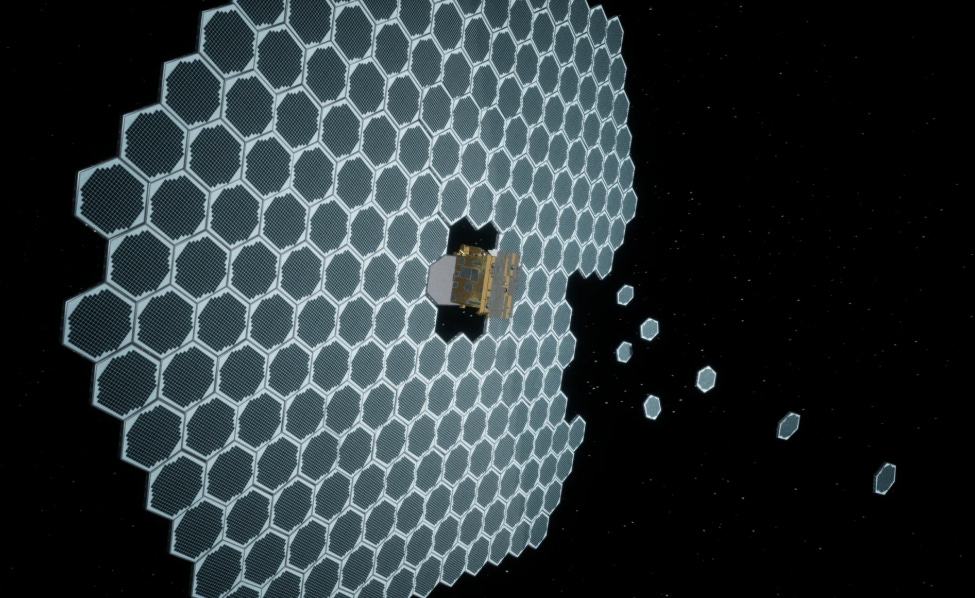
Image Credit: Rendezvous Robotics
There has been much discussion in the space community recently about building large data centers in orbit, then beaming data to Earth to avoid the environmental consequences of sprawling computing facilities on the ground. These space-based data centers would have all the power they need up there, taking advantage of the always-on, free fusion reactor some 93 million miles thataway.
Proponents say this represents a natural step in the evolution of moving heavy industry off the planet’s surface, and a solution for the ravenous energy needs of artificial intelligence.
One company is even proposing a method for autonomous solar panel assembly …
Building Data Centers In Orbit
Side note, related. SpaceX is considering the idea of using their upcoming V3 Starlink satellites as orbiting data centers. We’ll surely be seeing more of this in the coming years.
High Ground
Wondering about that “Golden Dome” defense project you’ve heard mentioned in the news?
Curious how we’ll be protecting our on-orbit assets?
From questions about controlling the High Ground, proposals for the Golden Dome defense system, the push for resilient launch operations and more, the nominee to lead the Pentagon’s space policy, Marc Berkowitz, talks different ways to structure national security space …
DoD Space Policy Nominee Fields Questions on Org Structure, Golden Dome, China
Titan
We all know oil and water don’t mix. In fact we use that universal truth as a metaphor, as a way to say, for example, Aunt Bernice and Cousin Ollie just don’t get along.
Only … it may not be as universal a truth as we thought.
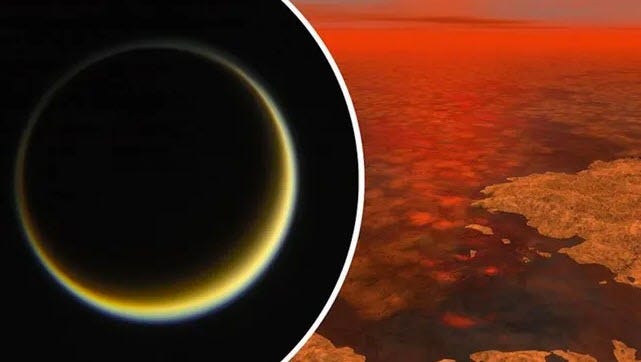
Image Credit: NASA-JPL-Space Science Institute
The frigid conditions on the surface of Saturn’s largest moon, Titan, allow simple molecules in its atmosphere to break one of the most fundamental rules in chemistry, a new study shows.
According to this principle, known as “like dissolves like”, mixtures containing both polar and nonpolar components, such as oil and water, usually don’t mix and instead form separate layers.
On Titan this isn’t the case.
(Does that mean Bernice and Ollie might have a chance after all?)
This new study challenges a long-held pillar of chemistry and could open the door to the discovery of more exotic solid structures across the solar system.
What else might we uncover right here in our own back yard …
Extra: When it comes to Titan, Saturn’s largest tether ball is interesting in more ways than one. While cold and bleak, it does have bearable surface pressures and could be survived with the right cold protection gear and, of course, breathing equipment. It’s bigger than Pluto and Mercury, and sports quite a few uncanny Earth-like features.
Could Titan become prime real estate for a new breed of hearty solar system settler?
Thanks for reading. As always, remember:
Space is the answer.

Tai’s Take

Space is hard.
“Doing” space is not for the faint of heart.
So much needs to be done to create a space future that’s real for all of us, it’s time we stepped up the pace.
Space is a goal we can, and should, focus on together.
Only … what can we do?
You, me, we’re just one person, right? And I don’t know about you, but I don’t have my own rocket yet.
What difference can we make?
The answer is pretty easy, and could be pretty fun:
Add space to the mix.
Live your life as you do, do your favorite things, watch your favorite shows, hang out with your favorite friends, go to your favorite restaurants and eat your favorite foods.
Among that, throw a little attention now and again toward space things.
Make a post. Mention it to a friend. Read an article, watch a video.
You’ll be surprised how that builds.
That’s my take.
PS - You can also share this post. 😉
Tai Rade ( / tie rah-day / ) is a former Space Marine turned space advocate. Hailing from nearby Proxima B, she’s become an active voice for our pursuit of space here on Earth, as well as taking on the role of spokesperson for Forty Suns.
Of Interest
The EarthLight Foundation has three guiding principles:
Protect & Expand the Domain of Life
Honor & Evolve Human Civilization
Explore & Experience the Universe
It’s an organization dedicated to a better future, a purpose we at Forty Suns share. Plus they have a really cool annual Cowboy Space Ball.
Check ‘em out.
Dad Said …
Did you hear about the restaurant on the moon?
Good food. No atmosphere.
Tell Your Friends!
If they’re not already subscribed, ask them pretty please to do so.
We need to get the word out about what’s happening in space!
It’s important we all start paying a little more attention.
You already are, and we love you for it.
Now let’s see who else we can get.
Share This Post:
Our Books
Two books make up the foundation of Forty Suns. One, our non-fiction book of the same name, Forty Suns, tells the tale of the coming space age and how it will impact each of us. The other, a fiction book titled The Girl in the Orange Beret, is the background story for Tai Rade.
Forty Suns: The Coming Space Age & You
Be one who knows:
Where we’re at in the new space age.
Where we’re going.
How space is changing the world for the better.
How to keep up.
Who the major players are.
Who they will be in the future.
What it will take to become multiplanetary.
What you can do.
Why space is important.
Why each of us matter.

The Girl in the Orange Beret: An Adventure in Hope
If you could change the world, would you?
Faced with impossible choices she must make, decisions she never would’ve imagined having to face, Tai Rade — Space Marine, sister, squad leader, friend — finds herself at the crux of a series of truly epic events that could alter the course of her world.
For the worse, or for the better.
The choices she makes will decide which.
Incredibly, her ultimate decision may change not only the future of her own world, it could set her on a path to change the future of ours as well.
The girl in the orange beret just might save us all.
